You wouldn't trust a car that had never been road-tested. Backtesting is how a trading strategy gets its road test. It's the backbone of serious automated trading, and understanding it changes how you evaluate every EA you'll ever see.
What is backtesting?
Backtesting is the process of running a strategy's rules against past market data to see what trades it would have taken and what the outcome would have been. Because an Expert Advisor is deterministic, a backtest reproduces its decisions exactly - every entry, exit, stop and target - over months or years of history in minutes.
Why backtesting matters
Three reasons it's indispensable:
- It replaces opinion with data. Instead of 'this looks good', you get measurable results.
- It reveals worst-case pain. You see the maximum drawdown *before* you live through it.
- It lets you compare. Two strategies, same data, objective comparison.
Protecting an account through those worst-case stretches is the job of risk management - backtesting is how you measure whether the strategy's risk behaviour holds up.
What a backtest report shows
A typical report includes the equity curve plus headline metrics. Here's a real MaxusBlast run on a $3,000 account:
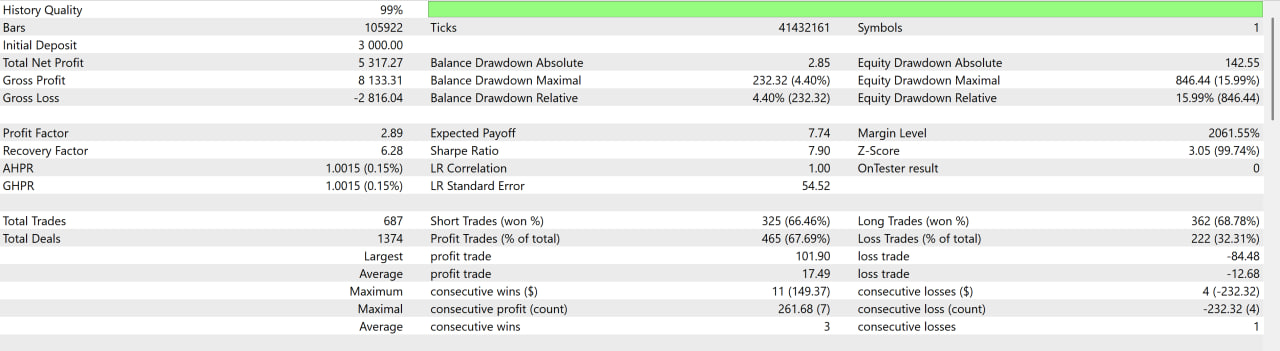
The numbers to read first are profit factor (gross profit ÷ gross loss), maximum drawdown (the worst peak-to-trough drop), the number of trades, and the test period. A great return over just 12 trades in one calm year means very little.
The limits of backtesting
The classic failure is curve-fitting: tuning a strategy until it looks perfect on one dataset, capturing noise instead of a real edge. The defences are testing across varied market conditions, using realistic spreads and commissions, and forward-testing on a demo account before going live.